Hedgehood in one page
Everything here runs on Robinhood's tokenized US stocks (NVDA, TSLA…). Five ways in. Each gets one picture, the live page and the links.
| You are | Put in | Get | Paid in / how often | Where |
|---|---|---|---|---|
| Hedgefun creator | 0.0005 ETH launch fee (first buy optional) | your cut of the sell tax (up to 50%), for as long as it trades | stockevery sell | hedgefun.trade/launch |
| Hedgefun holder | buy the token | buys burn it, treasury profit buys it back and burns it; supply only goes down | burnevery buy / by rule | hedgefun.trade |
| Keeper (anyone) | gas | 0.1% of every treasury call you send | the assetevery call | who does what |
| $HEDGE holder | hold ≥ $50 | 20% of the trading tax, pushed to your wallet | NVDAtwice a day | /hedge/payout |
| $HEDGE staker | any amount, 7-day unstake | 10% of Stock Yield's fee, by stake; payouts still count; 10k opens v1 deposits | USDGweekly claim | /hedge/stake |
| Hedgehog NFT | mine it + 0.065–0.165 NVDA | stake → payout boost 1.2–2.0×, or burn it for $HEDGE | boostevery round | /mine |
| Depositor (Stock Yield) | stock or USDG | weekly option premium, kept in the share price | USDG→NAVweekly | /stockyield/funds |
| Stock lender (StockLend) | stock | the fee weekend shorts pay to borrow it | USDGper loan | /lending |
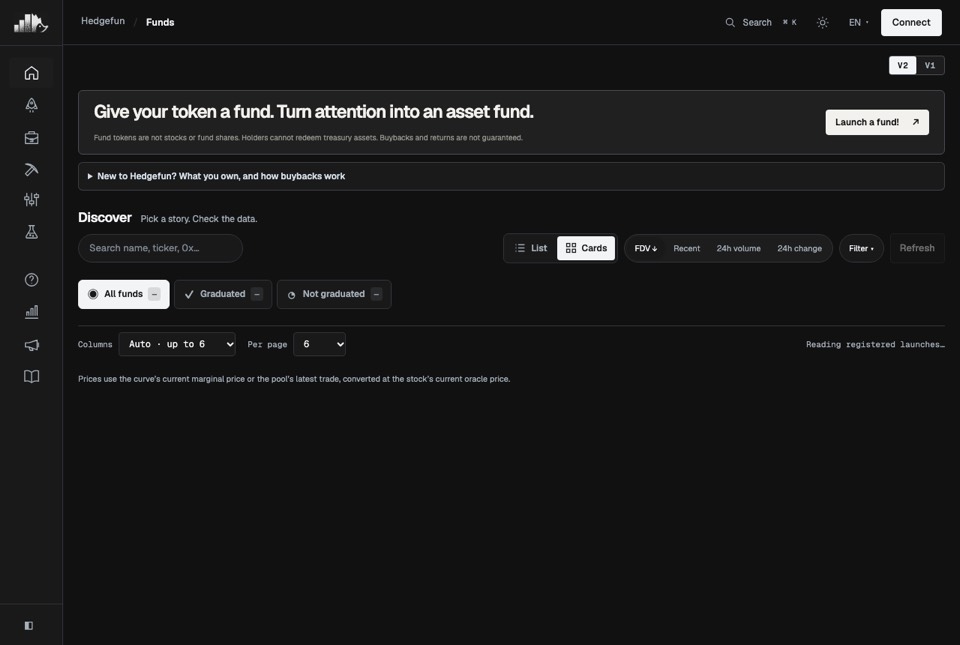
01Hedgefun: write a strategy on a stock, launch a token
Pick a stock, pick a rule, launch. The token sells on a curve; after graduation its treasury trades that stock by the rule and burns the token with the profit.
- Curve → graduation: pay in the stock, opens near $2.1k FDV, graduates after about $8.2k raised, near $50k FDV.
- At graduation: 70% seeds a Uniswap v4 pool locked forever, 30% becomes the treasury and the rule switches on.
- Buys burn the token. Sells pay a 1–15% tax (creator's pick) in stock: 30% protocol, up to 50% creator, the rest to the treasury.
- Assets: 18 stocks and ETFs (NVDA, TSLA, MSTR, GME, SPY…), plus ETH since 10/17.
- Holders: no redemption, no dividend; the burns are the link. Nobody can change the rule after launch.
Risk No trading, no tax. The treasury is long the stock and waits out a fall. The token can go to zero.
02$HEDGE: hold it, get paid NVDA
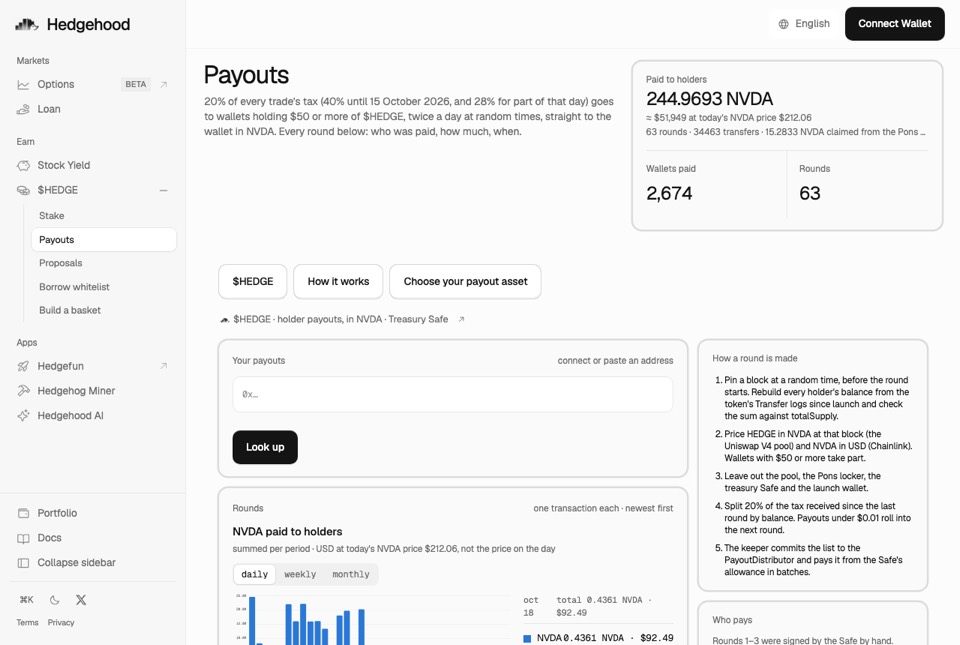
Every $HEDGE trade pays 3.33% in NVDA. 20% goes straight to holders twice a day; 80% is treasury stock that lends and sells options, and that income buys $HEDGE back.
- To qualify: hold ≥ $50. Snapshot at a random time, split by balance, nothing to claim.
- Stake $HEDGE (any amount): weekly USDG, 10% of Stock Yield's protocol fee split by stake. Staked $HEDGE still counts for payouts. 7-day unstake. 10,000 staked opens the NVDA Printer (v1).
- Stake a hedgehog NFT too → payout weight 1.2–2.0×. The two stakes stack (see 03).
- Vote: two proposals on /vote (borrowing against $HEDGE, payouts as an index). No stake needed.
Risk No volume, no payout. The treasury is long NVDA. $HEDGE is a memecoin and can go to zero. The holders' share moved from 40% to 20% on 10/15.
03Hedgehog NFT: mine one in your browser
Hedgehog Miner (HOG), 2,222 total. Proof-of-work in the browser, mint paid in NVDA. Stake it to boost your $HEDGE payouts, or burn it for $HEDGE.
- Get one: open /mine (WebGPU). One per block, about one every 90 s, first valid hash wins.
- Price: 11 epochs of 202 mints, 0.065 → 0.165 NVDA. Now 0.075.
- Use ①: stake 7/14/30 days → payout weight ×1.2 / 1.4 / 1.6 / 2.0 on up to 250k $HEDGE, best one per wallet. Keep ≥ $50 of $HEDGE beside it.
- Use ②: burn it → 40% of its mint price back in $HEDGE, from the reserve, first come first served.
- Where the mint NVDA goes: 45% buys $HEDGE and burns it, 15% buys into the reserve, 30% Safe, 10% builders.
Note The boost re-splits the holders' 20%, it does not add to it. A staked hedgehog cannot move until its term ends.
04Deposit: Stock Yield funds, weekly option premium
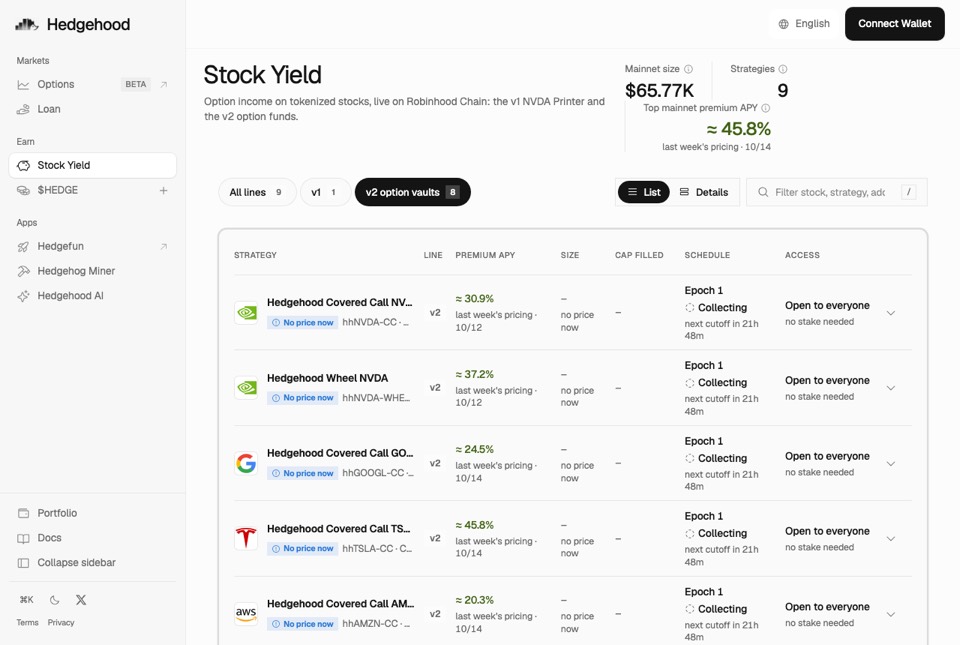
Deposit the stock or USDG. Every Monday the fund sells one-week options; the premium goes straight into the share price; Friday settles.
- 8 funds: covered calls on NVDA / GOOGL / TSLA / AMZN / META / AAPL / MSFT, plus an NVDA wheel.
- Open to everyone, no stake. Each fund caps at 100k USDG.
- Timing: Monday 09:30 ET cutoff → options sold → Friday close settles. Locked in between; no instant exit.
- Shares are ERC-20: send them or sell them. Redemptions pay the fund's current mix of stock and USDG.
- Fee: 20% of the premium. No deposit, exit or management fee.
Risk You are long the stock. Upside above the strike is sold. A week with no sale earns nothing. The APY on the page is last week's pricing, not a promise. No third-party audit.
05Lend stock: StockLend, paid by weekend shorts
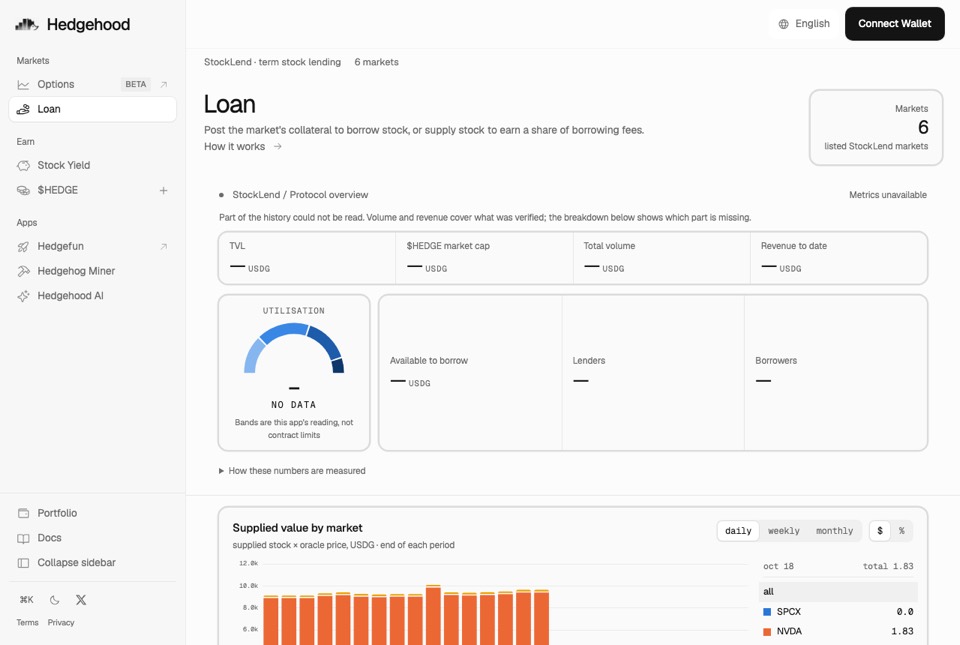
Supply the stock. Borrowers post USDG, borrow it and sell it. The fee they pay, in USDG, is yours.
- Why anyone borrows: the Chainlink feed stops for the weekend, the token keeps trading, often at a premium. Borrow, sell, buy back Monday when the feed returns.
- Fee: a share of the premium, paid once at the open. No rate curve.
- Protection: debt is marked at max(feed, pool TWAP), capped at feed × (1 + band). Past the band, the collateral is what covers you.
- No keeper: anyone can liquidate or buy in. 6 markets today.
Risk A real re-rating past the band can outrun the collateral. The issuer can pause the token. No borrowers, no income.
On-chain figures were read on 2026-10-18; the app shows them live. The contracts are reviewed internally, without a completed third-party audit. Not for U.S. persons or sanctioned jurisdictions. Not investment advice.
All documents
Hedgehood runs on Robinhood Chain (chain 4663), where Robinhood's tokenized US equities trade against USDG. Two protocols are live here, and both exist because a Chainlink equity feed is 24/5 while the token that tracks it is not. Stock Yield sells weekly options on tokenized stock: eight v2 funds on seven stocks, and the NVDA Printer (v1).
| Lending markets | our own two-price markets, not Morpho |
| Keeper role | none in StockLend: liquidation and buy-in are open to anyone |
| Owner | a Safe — parameters only, inside bounds the contract enforces |
| Network | Robinhood Chain, 4663 |
01 — StockLend · Two-price stock lending
Our own lending protocol. Debt is valued at whichever is higher — the Chainlink feed, or what buying the stock back out of the pool would actually cost — clamped at a band over the feed. Public, permissionless, and with no keeper role at all.
- Why an oracle-priced lending market is drained across a frozen weekend, with the MSTR event that showed it
- What a borrower pays and when the loan matures; what a lender earns and exactly where the protection stops
- Why a pushed pool cannot liquidate a collateralised loan, and the three attacks that were run against it
02 — The token · How $HEDGE works
A 3.33% tax on every trade: 20% is paid to holders in stock twice a day, 80% becomes treasury stock that is lent and runs options strategies for premium, and that income buys back $HEDGE. The treasury is long the stock and says so.
- Where the tax comes from and the four hops it takes to a holder's wallet, each one a contract rather than a person
- What the treasury's stock does on weekdays and on weekends, and why one share is never in two places
- Payouts come from the trading tax, buybacks from lending fees and option premium
03 — Live · Hedgefun Protocol v2
A launch sells its token on a bonding curve priced in a listed stock. At 79.31% sold, the crossing buy graduates it: 70% of the raise seeds a permanently locked Uniswap v4 pool and 30% becomes the capital of a treasury that trades the stock by one of seven rules the creator picks at launch. Every fee is taken in stock. Live on mainnet at hedgefun.trade.
- Quick start and the machine in pictures
- The protocol: contracts, parameters, the curve math, the seven kinds, the two-day controller
- Integration, who does what, and the mainnet address book
04 — Live · Stock Yield: the v2 funds
Eight funds on seven stocks (NVDA, GOOGL, TSLA, AMZN, META, AAPL, MSFT): seven covered-call funds and an NVDA wheel. Deposit the stock or USDG; every Monday a fund sells one-week options on what it holds, the premium is paid into the fund in USDG and stays in the share price, and every Friday the week settles. Shares are transferable ERC-20 tokens; money goes in and out at the weekly cutoff, paid in kind, with no instant exit.
- User guide: who can deposit, how a deposit, a redemption and a claim work, one week on a timeline, what each fund sells and what settlement does, what changed from v1, what can go wrong, the addresses
05 — Live · Stock Yield: NVDA Printer (v1)
The first vault, still running on its own contracts: a weekly covered call on NVDA. Deposit NVDA or USDG; every Monday the vault sells one listed call on all of it at the market's bid, and every Friday the week settles at NVDA's official close. The premium is paid as claimable USDG; the upside above the strike is what was sold.
- Quick start: four steps, one week on a timeline, and the three ways to get your money out
- Rules, roles and contracts: every bound the contracts enforce, who holds which key, how a week settles, why the operator is a contract that can only submit the sale, and the addresses