Share lending
Borrow USDG against your Stock Yield fund shares, or lend USDG to the people who do. It is one Morpho Blue market on Robinhood Chain: hhNVDA-CC shares are the collateral, USDG is the loan. Pledged shares stay in the fund, so they keep earning the weekly covered-call premium while they back your loan.
Lenders come in through a Morpho Vault V2 (hhUSDG) that lends only into this market, under a cap.

Open it at hedgehood.io/share-lending.
:::warning Read this part
A loan against fund shares is a loan against NVDA. If NVDA falls far enough, the share price falls with it and the position is liquidated: part of your shares is sold to repay the debt at a discount of about 12.7%. Earnings nights can move NVDA 20–30% overnight, while the market is closed. Lenders can be left with bad debt if a liquidation does not cover a loan. The contracts are audited by ExVul. Nothing here is investment advice or a promise of return.
:::
At a glance
| Collateral | hhNVDA-CC shares (the v2 NVDA covered-call fund) |
| Loan | USDG |
| Liquidation LTV (LLTV) | 62.5% |
| Most the app lends | 50% LTV — about a 20% fall in the share price before liquidation |
| Liquidation discount | about 12.7% (Morpho's incentive for a 62.5% LLTV) |
| Interest | Morpho's AdaptiveCurveIrm, aimed at 90% utilisation |
| Lending vault fee | 10% of the interest lenders earn; no management fee |
| Lending vault cap | 20,000 USDG |
| Risk changes to the vault | wait 24 hours |
Borrowing
- Get hhNVDA-CC shares. Deposit NVDA or USDG into hhNVDA-CC before a Monday cutoff; the shares are credited at that week's lock. Shares bought or received from someone else work the same way.
- Supply collateral. On the market page, open Borrow, enter the shares and approve them to Morpho Blue.
- Borrow USDG. Enter the amount. The app stops at 50% LTV; the chain itself allows up to 62.5%.
- Repay any time, in part or in full, and withdraw the shares once the debt allows it.
Interest accrues every second and is added to the debt. Your position, LTV and the share price at which it would be liquidated are shown under Borrow once a wallet is connected.
Shares in the fund's redemption queue cannot be pledged, and pledged shares cannot be queued for redemption: to leave the fund, repay, withdraw the shares, then request the redemption.
Lever up (optional)
The borrowed USDG can go back into hhNVDA-CC: borrow, deposit into the next weekly cohort, and pledge the new shares after Monday's lock. Each round takes a week. At 50% LTV the exposure tops out near 2×, and losses grow with it.
Lending
- On the market page open Lend and enter the USDG. Approve it to the vault, then deposit.
- The vault supplies it to the market at once and gives you vault shares (hhUSDG) that grow with the interest.
- Withdraw any time, up to what is not lent out: the vault's idle USDG plus what the market can pay back. When borrowers hold almost all of it, a withdrawal waits until they repay or new USDG comes in; the rate rises steeply in that case, which is what brings it back.
What lenders earn. Borrowers pay interest on what they borrow; lenders share it in proportion to what they supplied, less the vault's 10% fee. With nothing borrowed the rate is 0%. The Lend tab shows today's rate after the fee and, while nothing is borrowed, what it would be once 90% is borrowed.
You can also supply to the Morpho market directly, without the vault; the vault adds the cap, the timelock and an emergency stop on top.
How the interest rate works
The market uses Morpho's AdaptiveCurveIrm, the same model as Morpho's own markets. It aims for 90% of the supplied USDG to be borrowed:
- At any moment the borrow rate follows a curve: a quarter of the rate at target when nothing is borrowed, the rate at target at 90% utilisation, four times it at 100%.
- The rate at target moves on its own. While utilisation stays above 90% it rises (up to doubling in about five days at full utilisation); while it stays below, it falls. A new market starts at 4% a year.

The market page's Rates section draws the curve and the rate history.
How shares are valued
Morpho needs a price for the collateral. The market's oracle (ShareRiskOracle) values one share as a
conservative lower bound of what it is worth:
- What the fund holds: its NVDA at the Chainlink NVDA price, plus its USDG.
- Minus the calls it has sold this week: each open call is valued at Black-Scholes with the volatility implied by its own premium, stressed 1.5×. That is what a rally would cost the fund before Friday.
- Nothing for this week's premium until Friday's settlement adds it to the fund.
So the oracle price sits a little below the fund's NAV per share during the week (for example 0.981 against 1.005) and moves back up after settlement. The market page's Risk section shows both.
When there is no live NVDA price:
- Market closed (nights, weekends, holidays): the last price is held.
- Market open but no fresh price (a stale or paused feed): the last price is held for 48 hours, then cut by 0.5% an hour, down to at most half.
- A corporate action on the NVDA token (an issuer pause, a split or other multiplier change): the oracle stops quoting. Borrowing, withdrawing collateral and liquidations pause until a price exists again; repaying, supplying and withdrawing loans never need a price and keep working.
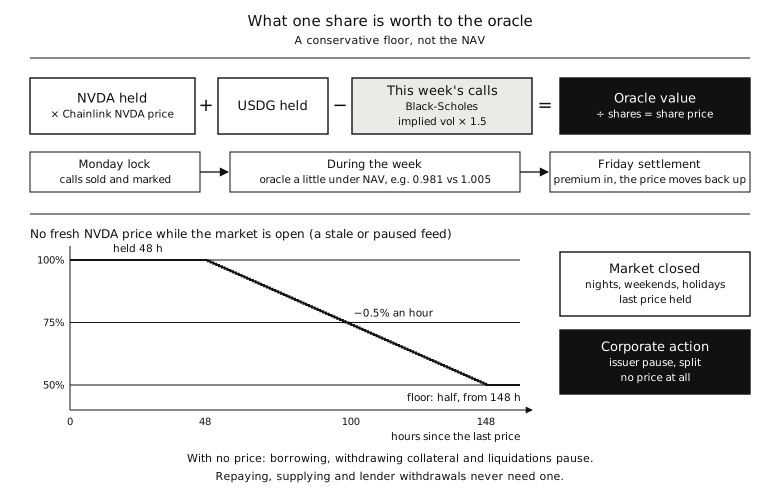
After every Monday lock the week's open calls are marked (their volatility is recorded) so the oracle can price them. Marking is permissionless and only ever raises the price.
Liquidation
A position can be liquidated once its debt is above 62.5% of its collateral's oracle value. A liquidator repays part
or all of the debt and receives shares worth that much plus about 12.7%. Liquidations go through Morpho Blue and are
open to anyone; the LiquidationHelper contract lets a liquidator take the seized shares straight into the fund's
redemption queue instead of holding them.

If a liquidation leaves debt with no collateral behind it, Morpho books it as bad debt and lenders share the loss.
Safety and control
The lending vault is owned by the Hedgehood Safe (2 of 3), which is also its curator and allocator.

- Anything that adds risk waits 24 hours: raising the cap, adding a market or an adapter, changing fees, gates or the timelock itself. A pending change is visible on chain for the whole day before it can apply.
- Anything that reduces risk applies at once: cutting the cap to zero, pulling USDG back from the market, revoking a pending change. Two sentinels can do this — the Safe and a team key — so new lending can be stopped in one transaction.
- Morpho Blue has no admin pause: nobody can stop the market. Existing loans keep running and repaying always works. Liquidations need an oracle price, so they pause with borrowing whenever the oracle stops quoting (see how shares are valued).
What can go wrong
- NVDA falls. The share price falls with it. At 50% LTV a fall of about 20% reaches liquidation; an overnight gap can skip straight past it.
- The covered calls. Above the strike the fund's upside is sold, so the share price does not follow a rally.
- No price. A corporate action stops the oracle; a long feed outage cuts the price step by step and can liquidate a position a live price would call healthy.
- Liquidity for lenders. USDG that is lent out can only be withdrawn once it is repaid.
- Bad debt. A gap larger than the liquidation buffer can leave a loss for lenders.
- The fund. Everything on the fund guide applies to the collateral.
- Low rates at first. A new market starts at 4% a year at target and only rises once it is well used.
Contracts
Robinhood Chain (4663). Deployed 2026-10-26. Source:
github.com/0xHedgeHood/hedgehood-vaults,
contracts/src/collateral/.
| Address | |
|---|---|
| Morpho Blue (Morpho's deployment) | 0x9D53d5E3bd5E8d4Cbfa6DB1ca238AEA02E651010 |
| Market id | 0x789202f84d066bdad8115d39d5dea0af80ccd52dd6727461d98daa638ed9b7aa |
| ShareRiskOracle | 0x6EcA44BBB41D3176A451910C4f735A51AdAb4237 |
| V2FundLens (the oracle's view of the fund) | 0x07F1086f26a75b88dA527FD6DFffDbAf4910Ac97 |
| LiquidationHelper | 0x7916AA79486863C73e446D3C7b771cEcb502d65a |
| AdaptiveCurveIrm (Morpho's deployment) | 0x2BD3d5965B26B51814AC95127B2b80dD6CcC0fa1 |
| Lending vault hhUSDG (Morpho Vault V2) | 0x54Bc097643BB9fd4ab004f11859893655529E954 |
| Vault adapter (Morpho Market V1 adapter) | 0xdEbAd49D242967CBf0DDAe8626873ad54cF7878A |
| Collateral: hhNVDA-CC | 0x4a1c42b0E0D229B677D574d3dCdc2A5Dff848373 |
| Loan: USDG | 0x5fc5360D0400a0Fd4f2af552ADD042D716F1d168 |
| Owner, curator and allocator Safe (2 of 3) | 0xB5C9e27F50599687eD141ABe337414B79061489b |
Oracle settings: volatility stress 1.5×, hold 48 hours, then −0.5% an hour to a floor of 50%; USDG/USD feed at most 25 hours old.
Next: Stock Yield funds (v2) · glossary